By Dr. Mitch Keil
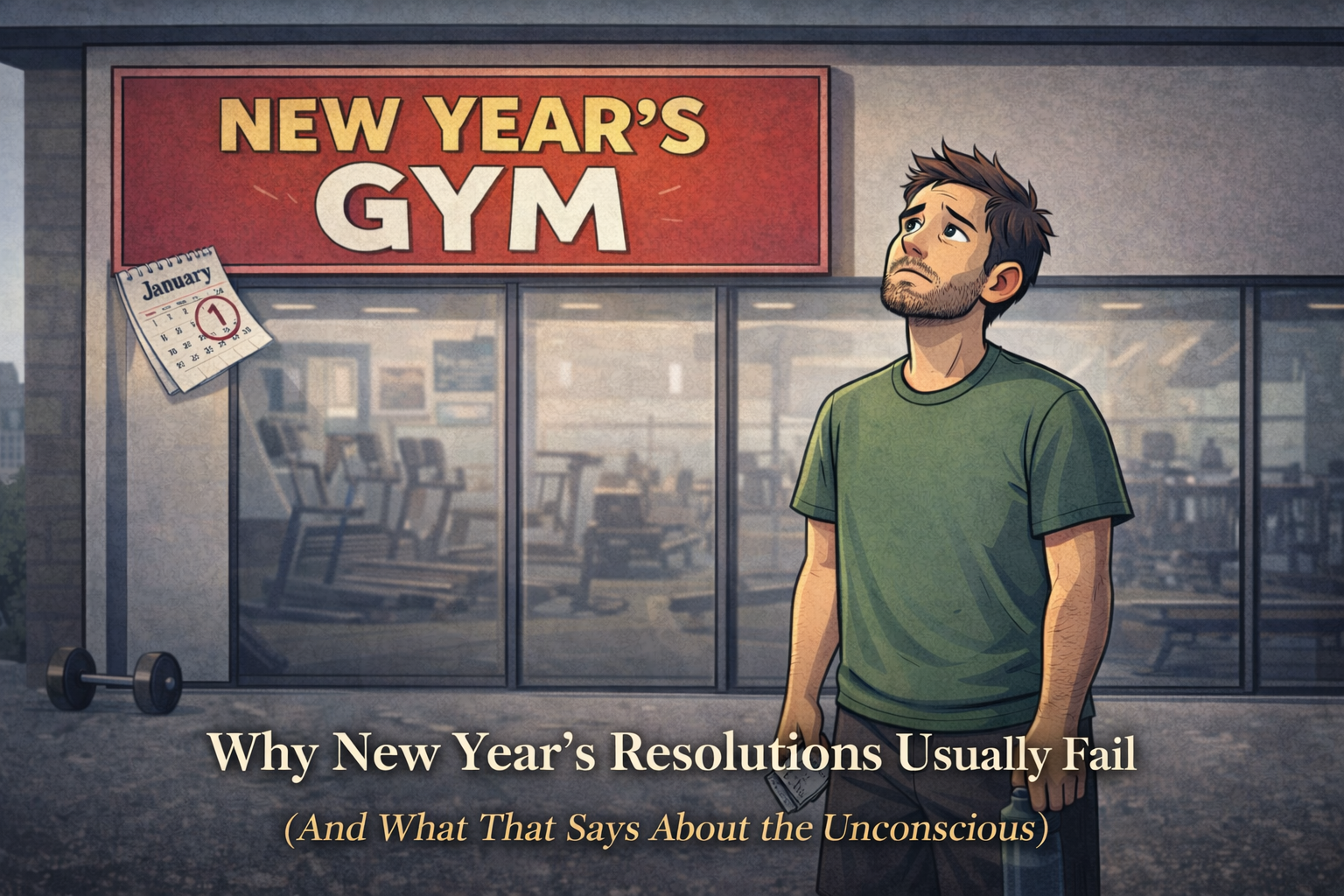
Every January, the same ritual repeats itself.
Gym memberships spike. Productivity apps get downloaded. Promises are made—to wake earlier, drink less, work harder, finally “get it together.”
And then, quietly, almost predictably, it falls apart.
By mid-January or early February, most resolutions are abandoned. What follows isn’t neutrality—it’s usually shame.
“I lack discipline.”
“I just don’t want it badly enough.”
“Other people can do this. Why can’t I?”
From a psychodynamic perspective, New Year’s resolutions don’t usually fail because of laziness or weak willpower.
They fail because they are often defenses against something far more uncomfortable.
They fail because they’re built on unacknowledged grief.
The Emotional Undercurrent of the New Year
The end of the year does something subtle but powerful to the psyche.
It forces a reckoning.
Time has passed. Another chapter has closed. Another version of your life—imagined or hoped for—did not fully materialize. Even when life is objectively “good,” there is often a quiet, background sadness this time of year that people can’t quite name.
You’re not just saying goodbye to a calendar year.
You’re often grieving:
- The self you thought you’d be by now
- Relationships that didn’t deepen or last
- Choices you didn’t make—or made and regret
- The growing awareness that time is finite
This grief is rarely conscious. Our culture doesn’t make much room for mourning unrealized selves. So instead of slowing down and metabolizing it, we tend to bypass it.
Enter the New Year’s resolution.
Resolutions as Manic Repair Attempts
Psychodynamically, many resolutions function as a manic repair attempt.
That doesn’t mean “crazy.” It means a sudden surge of optimism, control, and effort designed to outrun vulnerabilityVulnerability refers to the willingness to expose one’s feelings, thoughts, and experiences in a g....
Rather than sitting with disappointment, uncertainty, or loss, the psyche says:
I’ll fix it.
I’ll outwork it.
I’ll reinvent myself.
The fantasy is seductive:
“If I become a new version of me, I won’t have to feel what I’m feeling.”
But the unconscious doesn’t work that way.
You cannot sustainably build change on top of disavowed grief. What hasn’t been mourned will eventually demand attention—often through resistanceResistance refers to the client's unconscious defense mechanisms that prevent them from confronting ..., procrastination, exhaustion, or self-sabotage.
So the resolution collapses. And the shame cycle begins.
The Superego Problem
Another reason resolutions fail is that they’re often issued from the superego, not the self.
They sound harsh, rigid, and absolute:
- “No more excuses.”
- “This year I’m finally getting disciplined.”
- “I shouldn’t be like this anymore.”
These aren’t invitations to growth. They’re internal ultimatums.
From a depth perspective, the unconscious does not respond well to coercion. Parts of you that are tired, scared, ambivalent, or grieving don’t disappear because January 1st arrived.
They dig in their heels.
The more aggressive the resolution, the stronger the internal resistance—and the harsher the self-attack when it fails.
Why January Feels Worse for Some People
For many high-functioning adults, January isn’t energizing—it’s destabilizing.
The pressure to feel “fresh” or motivated creates a sense of emotional falseness. If you feel heavy, reflective, irritable, or numb, it can seem like something is wrong with you.
Nothing is.
What’s happening is that the illusion of infinite time takes a small but meaningful hit at the turn of the year. That’s an existential reality most of us were never taught how to process.
So we compensate with productivity.
Real Change Requires Mourning
Here’s the part that doesn’t sell planners or programs:
Lasting change usually begins not with motivation—but with mourning.
Mourning who you are not.
Mourning what didn’t happen.
Mourning the fantasy that you can become someone else without integrating who you already are.
Therapy, at its best, doesn’t help people become “new.”
It helps them become more whole.
When grief is acknowledged rather than bypassed, something shifts:
- Self-compassionSelf-compassion is the practice of treating oneself with kindness and understanding during difficult... replaces self-violence
- AmbivalenceAmbivalence refers to the coexistence of opposing feelings or attitudes toward a person, situation, ... becomes workable instead of paralyzing
- Change emerges organically, not through force
Ironically, this is when behavior actually starts to change.
What Actually Helps Change Take Root
From a psychodynamic perspective, meaningful change doesn’t start with willpower. It starts with turning toward the parts of you that have been driving the struggle in the first place.
If you want this year to unfold differently, here are a few places to begin—not as hacks, but as internal tasks.
1. Identify What You’re Defending Against
Ask yourself—not rhetorically, but honestly:
What feeling does my push to “do better” help me avoid?
For some people it’s grief.
For others, shame, fear of stagnation, anger, or a long-standing sense of failure.
When improvement becomes urgent, rigid, or frantic, it’s usually a sign that something underneath hasn’t been metabolized yet. Until it is, the psyche will keep prioritizing defense over growth.
2. Listen to the Voice Behind Your Goals
Notice how your resolutions sound internally.
Do they feel curious and grounded—or harsh and absolutist?
If the voice driving change is punitive (“I should already be past this”), that’s the superego at work. And while the superego is excellent at criticism, it’s terrible at sustaining growth.
If you wouldn’t speak to someone you love the way you speak to yourself about your goals, that’s not motivation—it’s internalized attack.
3. Make Room for Ambivalence Instead of Fighting It
One of the most common reasons people stall is unacknowledged ambivalence.
A part of you may genuinely want to change.
Another part may be exhausted, scared, attached to familiarity, or protecting something important.
When we pretend ambivalence doesn’t exist, it doesn’t disappear—it just sabotages quietly.
Psychodynamically, progress happens when competing parts are understood, not overridden.
4. Shift the Goal From Reinvention to Integration
This is the deepest pivot.
Most New Year’s resolutions are built on the fantasy of becoming someone else. But sustainable change comes from integrating who you already are, including the parts you wish weren’t there.
The procrastinator.
The avoider.
The one who burns out.
The one who learned early on that striving was safer than feeling.
These parts didn’t appear randomly. They developed for reasons. When those reasons are understood, the behaviors no longer have to fight so hard to stay in place.
A Different Definition of a “Fresh Start”
A psychologically meaningful fresh start doesn’t look like a clean slate.
It looks like:
- More honesty about what hurts
- Less violence toward yourself in the name of growth
- A willingness to slow down enough to understand why you do what you do
That’s not glamorous. It doesn’t sell well. But it works.
And paradoxically, when people stop trying to force change and start trying to understand themselves, behavior often shifts—quietly, steadily, and for good.
You don’t need a new version of yourself this year.
You may need a deeper relationship with the one you’ve been trying to outgrow.